23 February 2026
National Gas publishes response to the Government’s Gas System in Transition: Security of Supply consultation
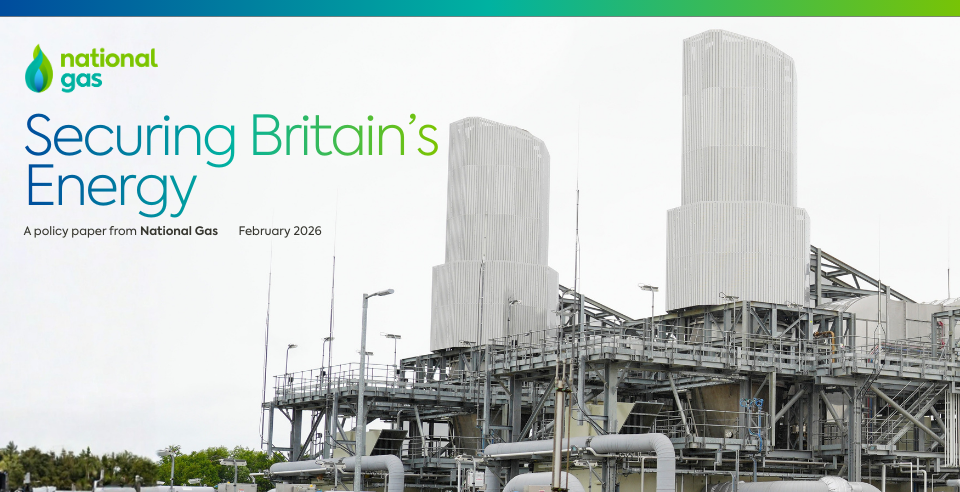
Today (Monday 23 February 2026), National Gas has published a policy paper summarising its response to the Government’s Gas System in Transition: Security of Supply consultation which closed on 18th February.
In a paper, entitled Securing Britain’s Energy, National Gas details its assessment of the risks to gas security of supply and outlines a range of policy options to safeguard Britain’s future energy security.
National Gas argues that the right combination of policy options - balancing affordability, security, and the pace of decarbonisation - depends on the Government first establishing Britain’s risk appetite through a new national supply security standard.
Emerging risks
The assessment of risk detailed in the paper concurs with recent analysis outlined in National Gas’ annual Winter Outlooks, NESO’s 2025 Gas Supply Security Assessment and in the Government’s consultation and points to potential security of supply margin deficits in the coming years.
For decades, Britain has benefited from a secure and reliable energy system. However, systemic change, such as declining North Sea production, increased reliance on imports, and shifting demand patterns, is creating new challenges and risks.
Against this backdrop, National Gas has welcomed the Government’s review as the right mechanism to determine Britain’s national risk appetite and identify the interventions required to meet the future demands of a rapidly evolving energy system.
National Gas is calling for swift and decisive action from Government, regulators, and industry to mitigate potential near-term risks and safeguard Britain’s long-term energy security.
Three core aims for Britain’s long-term gas security-term gas security
In its response, National Gas sets out policy options under the three core aims it considers should underpin Britain’s future approach to gas security of supply.
These options have been developed based on the scenario that assumes Britain should continue to operate within its existing operating supply margins.
Establish Britain’s risk appetite and introduce new gas supply standard
National Gas recommends defining a clear national risk tolerance and updating security standards to include “deliverable commodity” (gas supplies). This should include:
- Defining the level of risk Britain is prepared to tolerate across credible supply-demand scenarios.
- Maintaining the existing “N-1 infrastructure” (security against the loss of the single piece of NTS infrastructure) and the “1in20” (1-in-20-year peak gas demand) planning standards.
Introducing a new “deliverable commodity” standard (supplies of gas), based on NESO’s Gas Supply Security Assessment methodology, to ensure Britain has sufficient gas supplies under stressed conditions.
2. Develop a future-proofed and competitive gas market
National Gas recommends a programme of market updates to ensure the system remains resilient, competitive and responsive to future challenges. This includes:
- Updating gas quality standards, including reviewing an increase in the “Wobbe Index” – the measure which shows how interchangeable one type of gas is with another.
- Introducing a single National Transmission System (NTS) capacity reference price to improve competitiveness.
- Exploring opportunities to optimise remaining UK Continental Shelf (UKCS) production, where economically and environmentally appropriate.
Instigate a government and Ofgem-led review into whether Britain should adopt greater-term contracting within the gas supply mix, like in other countries, to combine greater-term contracts with spot purchasing.
3. Strengthen gas network and supply infrastructure resilience
National Gas recommends targeted interventions and clear national direction to ensure network and midstream infrastructure are resilient for the future. This includes:
- Targeted upgrades across the NTS, including reinforcement projects to remove potential constraints on key pipelines.
- Working with industry to maintain and enhance flexible supply capacity, including storage. LNG expansion and the introduction of Floating Storage Regasification Units (FSRUs) - as required by any new security standard.
- Exploring commercial incentives for merchant interconnectors and other flexible supply infrastructure to maintain their enduring commercial viability.
If implemented, National Gas believes these recommendations could significantly reduce any potential deficits to within existing, acceptable operating margins.
Jon Butterworth, Chief Executive of National Gas, said:
“The risks ahead are clear and our assessment of the energy security challenges facing Britain is consistent with those set out by Government and the National Energy System Operator.”
“In recent years, our analysis has consistently highlighted the risks associated with the decline in domestic production and our growing reliance on imports. Now is the time to meet these challenges collectively through a co-ordinated, pragmatic and forward-looking approach. However, swift and decisive action is also required to address potential near-term challenges, and that work is already well underway.
“This is a defining moment for Britain’s energy security. The choices we make now will determine our resilience for decades to come. We commend the Government’s leadership on this critical issue and stand ready to work closely with NESO, Ofgem and industry to take the necessary steps to safeguard Britain’s long-term energy security. term energy security.
“While there are few easy answers, there are credible and deliverable options available. Although no single organisation holds all the levers, we have set out a range of policy options that we believe could strengthen our future energy security. Ultimately, however, the right solutions - balancing security, affordability and decarbonisation - depend on the level of risk the nation is prepared to accept.
“Gas will continue to play a vital role in maintaining Britain’s energy security, keeping the lights on, homes warm and industry powered, particularly during cold weather and periods of low renewable output. Ensuring the resilience and reliability of Britain’s gas network remains our top priority and is essential to delivering ongoing energy security and a successful energy transition.”
National Gas is the owner and operator of the gas National Transmission System (NTS) in Great Britain. Its role means it has the expertise and experience to advise government and offer an evidence-based perspective on Britain’s gas security needs.
Read the policy paper Securing Britain’s Energy here.
Related News
View Media & Insights

11 February 2026
National Gas apprentices join parliamentary roundtable on the future of skills
Find out more