24 June 2026
Humber Hydrogen has the potential to unlock billions in value to the UK economy
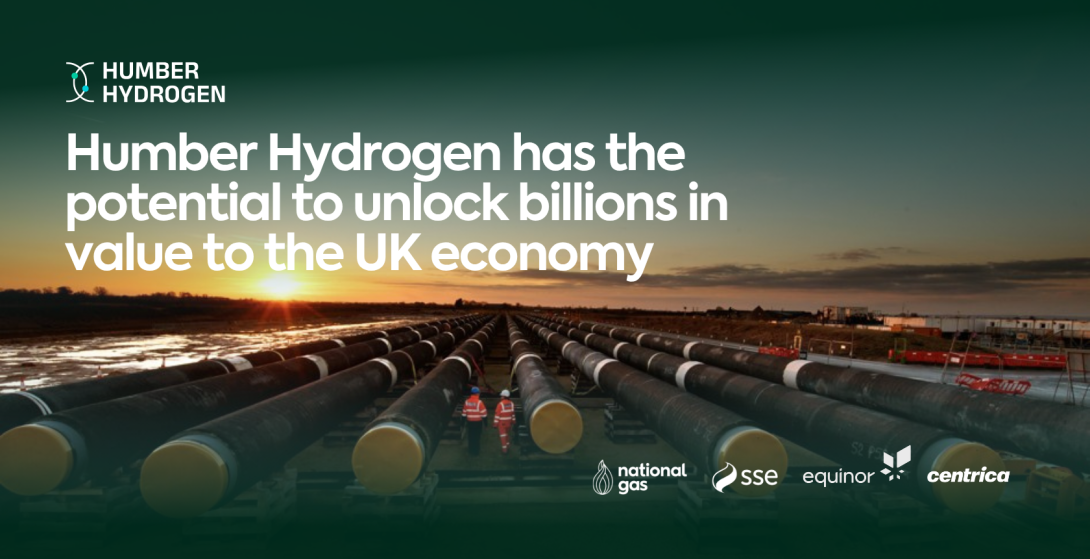
Awarding the UK Government’s £500 million Hydrogen Transport and Storage Business Model to the Humber could result in £17 billion of economic growth from the construction and operations of the cluster’s hydrogen assets.
According to independent analysis commissioned by Humber Hydrogen, it has the potential to support 53,000 jobs during construction and 900 sustained jobs during the operation of the UK’s first hydrogen cluster.
At its peak, the project would abate up to 5 million tonnes of CO2 per annum of the UK’s largest emitting industrial cluster, which currently emits 20 million tonnes of CO2 per year.
The first-of-its-kind hydrogen cluster in East Yorkshire and North Lincolnshire will be delivered by four of Britain’s leading energy companies - Centrica, Equinor, National Gas, and SSE Thermal. Together they’re bringing their expertise in hydrogen transport, production, usage and storage to support the region’s industries, reduce emissions, and create jobs.
Speaking on behalf of Humber Hydrogen, Ian Radley, Chief Commercial Officer at National Gas, said;
“The Humber’s industrial heft makes it the obvious choice as the location of Britain’s first hydrogen network. East Yorkshire and North Lincolnshire have the industrial demand, infrastructure, supply chains, skilled workforce, and geological assets to deliver Britain’s hydrogen capability.
“Unlocking hydrogen’s potential in the Humber will unleash economic growth and propel both the region and Britain into a new era of global leadership in low carbon industry.”
Hydrogen can enhance Britain’s energy security by providing flexible, cleaner energy for our power system and industries. As an alternative fuel to natural gas, it can be used to decarbonise power generation and hard-to-electrify industries such as heavy manufacturing, chemicals and steel production. It can also be used as a feedstock for high-value products such as ammonia and Sustainable Aviation Fuel (SAF).
Clare Jackson, CEO, Hydrogen UK, said;
“This analysis underlines what the hydrogen sector has been saying clearly: hydrogen is a major economic growth opportunity for the UK. The Humber is exactly the kind of industrial region where hydrogen can attract investment, support skilled jobs and help energy-intensive businesses remain competitive.
“By building the pipelines and storage we need to connect hydrogen production with demand, projects like Humber Hydrogen can help deliver stronger energy security and crucial economic growth for the UK.”
The Humber is already leading Britain’s hydrogen economy with:
- Six power stations in the region, investing in more than 4 GW hydrogen-to-power – that’s more than 10% of Britain’s average electricity demand.
- Two blue and five green hydrogen projects, owned by different producers, delivering approximately 3GW of low carbon hydrogen.
- 65% of the UK's total potential new-build storage capacity for hydrogen is in East Yorkshire. Natural salt caverns at Aldbrough are already used for existing gas storage and this will be adapted and extended with new caverns for safe hydrogen storage to develop one of the largest of its kind in the world.
Speaking about the project’s potential, Melanie Onn is the Labour MP for Great Grimsby and Cleethorpes, said;
“The Humber has long been the UK’s industrial powerhouse, and today it stands ready to lead the transition to a clean energy future. Humber Hydrogen represents a historic opportunity to decarbonise industry, deliver clean power, safeguard thousands of skilled jobs, and unlock new investment across our region. I’m proud to support this landmark project and to help champion the Humber’s role at the heart of Britain’s hydrogen future."
Humber Energy Board’s Managing Director, Dr Iain Harris, said;
“This analysis reinforces the strength of the Humber’s case to host the UK’s first regional hydrogen transport and storage network. The region brings together significant industrial demand, credible hydrogen production, proven salt-cavern storage capacity, world-class port infrastructure and experienced partners ready to deliver.
“That is why Humber Energy Board is calling on the UK Government to allocate its £500 million hydrogen transport and storage support to the Humber and select the region’s proposals. Backing the Humber would accelerate industrial decarbonisation, strengthen UK energy security, unlock private investment and create skilled jobs and supply chain opportunities for communities across the region.”
Yara International is a global leader in crop nutrition and low‑carbon energy solutions, with a longstanding presence in the UK. Its Hull site is the country’s only production‑ready ammonia plant, representing a strategically important asset for food security, industrial resilience and the low‑carbon transition. With the capacity to produce up to 300,000 tonnes of ammonia annually, the plant has historically supported fertiliser supply chains across the UK and Europe. Currently mothballed, the facility is maintained in a restart‑ready state, with future operations dependent on access to reliable low‑carbon hydrogen and supportive policy frameworks.
Anita Nyvold, VP Energy Sourcing at Yara International, said;
“Yara’s Hull plant can contribute to both UK food security and the transition to low‑carbon industry. Access to reliable, low‑carbon hydrogen is critical to restart Yara Hull and enabling the production of low‑carbon ammonia at scale. Projects like Humber Hydrogen can play an important role in providing the infrastructure needed to decarbonise industry, support skilled jobs, and strengthen the UK’s industrial competitiveness.”
About the data
The analysis reflects how we anticipate the Humber Hydrogen network – its projects and up to 90 miles of pipeline - will operate at inception. The economic impact analysis undertaken as part of this study calculates direct, indirect and induced GVA and job impacts associated with hydrogen production, transport and storage, and hydrogen to power projects, considering development (2026-28), construction (2029-38) and a 30-year operational phase starting from 2033. Emissions reductions are estimated based on the carbon intensity of natural gas being displaced by peak annual production of low-carbon hydrogen from 2040.
The data does not reflect the Humber’s CCS projects, hydrogen for home heating, hydrogen for heavy transport, nor future expansion potential.
Additional future users may emerge and add greater value but are not reflected in this analysis, to reduce unsubstantiated assumptions.
We have developed these figures with the support of KPMG LLP using a fact-based quantification of benefits using industry benchmarks and data provided by the Humber Hydrogen partnership.
Related news
View Media & Insights
23 June 2026
Gas is critical to Britain’s energy security during periods of low renewables, analysis shows
Find out more
22 June 2026
Working together to keep Britain’s energy secure: joint Q&A with National Gas and NESO
Find out more