8 October 2026
National Gas’ 2026 Autumn Budget Submission
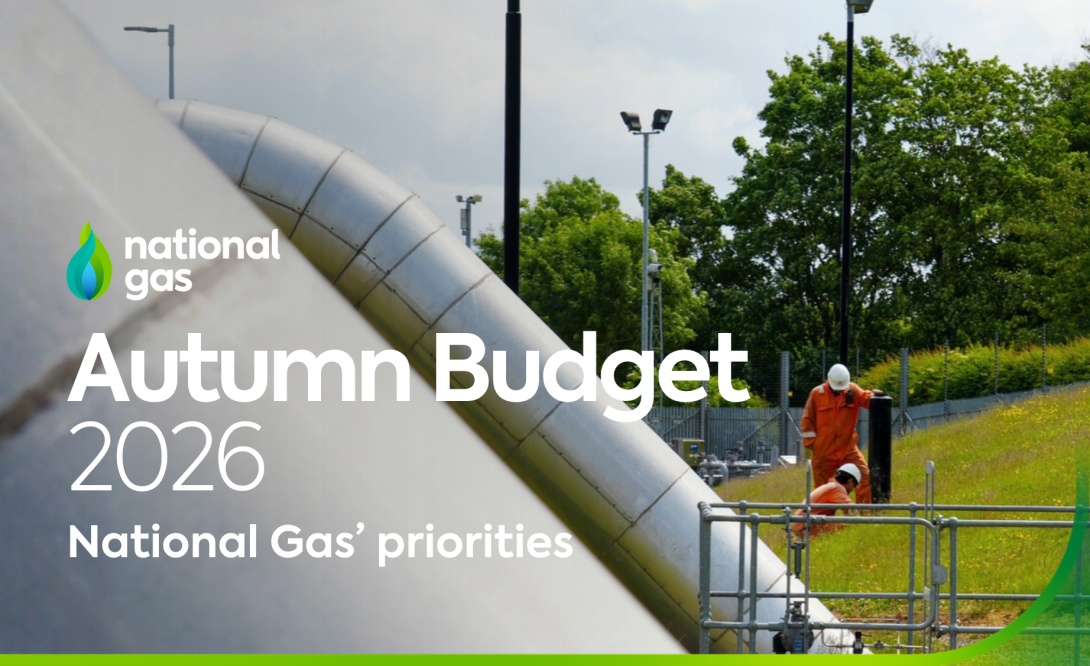
As Britain's Gas System Operator, National Gas plays a critical role in maintaining the country’s energy security.
We keep energy flowing to power stations, major industries, storage, more than half a million businesses and 24 million homes, while developing the infrastructure to support Britain’s transition to a low-carbon energy system.
Drawing on our unique system-wide perspective, we have identified four priorities for the UK Government ahead of the 2026 Autumn Budget to strengthen energy security, support the energy transition, and drive economic growth across the country.
A reset on natural gas
Natural gas remains critical to Britain's energy security, regularly exceeding 60% of the country’s power generation on winter days. As renewable generation grows, gas will remain essential in providing flexible and dispatchable capacity when the wind doesn’t blow and the sun doesn’t shine.
At the same time, the gas system is undergoing significant change with declining UK Continental Shelf production and increasing reliance on imported gas.
The Autumn Budget presents an opportunity to provide certainty on the future of Britain's gas system by confirming the actions the government intends to take to address energy security, and the funding needed to support them.
We are calling on the UK Government to:
1. Publish the government’s final response to Gas System in Transition: Security of Supply consultation alongside the Autumn Budget and announce funding for the infrastructure and market interventions that the government intends to take forward. Further information on our response to the Security of Supply Consultation can be found on our website.
2. Support households with energy bills this winter by temporarily removing the 5% VAT from domestic gas bills, mirroring the measure introduced for electricity.
Strengthening Great Britain’s domestic energy capability
A secure, affordable and resilient energy system depends on the country’s ability to produce, transport and store more of its own energy. Achieving this will require accelerated deployment of biomethane and hydrogen, which can strengthen domestic energy capability, reduce reliance on imported energy and support reindustrialisation.
The government has already taken important steps to support hydrogen infrastructure. The focus must now shift from commitment to delivery to provide investors and supply chains need confidence that these commitments will be taken forward.
3. Biomethane: Allocate additional funding to the Green Gas Support Scheme (GGSS) as an interim measure to maintain momentum in biomethane deployment across Great Britain until a long-term, sustainable mechanism is introduced.
4. Hydrogen: Launch the first Hydrogen Transport and Storage Business Model competition at the Autumn Budget to determine the location of Britain’s first hydrogen cluster. At the same time, the Government should confirm whether the cluster is expected to be operational by 2030. Alongside Centrica, Equinor and SSE Thermal, National Gas will be submitting the Humber Hydrogen project into the first allocation round. The Humber is the UK’s most carbon-intensive industrial cluster, accounting for around 5% of national emissions, representing one of the country’s largest opportunity for industrial decarbonisation at scale.
Together these priorities will ensure that an energy system operating at our scale can provide the energy security to deliver growth in every postcode.
Related news
View Media & Insights

27 September 2026
New research finds that Humber residents back clean energy investment to revitalise the region
Find out more
18 September 2026
£30 million National Gas investment to boost jobs, skills and energy security in Derbyshire
Find out more